

Georgina’s Blog
Nearly the end of January – 2019 has flown by so far!!
It’s been such a long time since I’ve written a blog, been so busy doing many different things, especially having just finished my mock exams, applying to University, work experience and creating my other projects!
I can finally say I’ve sent off my UCAS application for University. I have applied to Leeds, Sheffield and Nottingham for Mechanical Engineering (MEng), Durham University for General Engineering (MEng) and Product Design Engineering at Loughborough University (MEng). I received conditional offers back from Leeds and Sheffield and an unconditional from Nottingham, and am looking forward to the post offer visit days that I will be going on soon.
Back to the topic of this blog though, the work experience around Portakabin!
On the 5th of December, I was shown around Portakabin in York by David Offen. David is the design and manufacturing lead, and has previously worked within the Aerospace Industry as well. He was very knowledgeable and informative about all of the processes occurring within the different units and gave me an excellent tour explaining all of the different manufacturing methods and systems that are in place. Seeing the systems in action that I’ve been learning about in the theory section of my Design and Technology A-level gave me a much deeper understanding.
Whilst sat in the reception at the beginning of the day, the companies mottos and policies were presented on the wall. Although I can’t remember them exactly, they covered issues such as teamwork, sustainability, efficiency and quality. These were clearly in place across the factory to allow Portakabin to complete their mission, “To provide peace of mind for our customers across Europe through quality products and services.”
As I explored further around Portakabin, it seemed to turn into Narnia, as it continued to expand further and further. There was something new, innovative and more advanced around every corner. Their modular buildings are all made in different units, some of which I went around. The units were built with the first one being made first and then the next, until the last one which has just been developed. This was very clear as the technology and systems within the manufacturing processes kept on developing, as we went into the more modern units.
The first unit had more workers in than the last, yet the last used more computer controlled (CNC) machinery. After having used a CNC router at school for the F1 in Schools Competition, David showed me their CNC router, which roughly filled the size of a normal room – crazy! The router allowed them to cut out panels accurately and to a good quality, whilst speeding the process up compared to if it was done by hand with a jigsaw.
Another major difference between the units was how the panel was moved between the different work stations, within the Unit Production System. Within the first unit, the panel had to move in a range of directions, across the unit from one workspace to another. The panel was held up on balancing boxes that ensured that the panel was flat so that any processes were done accurately to a high quality. Within the final unit, the panel was placed onto rollers along a track system on the floor, which moved the panel in a linear direction from one side of the unit to the other. David explained how the track along the floor was perfectly calibrated such that it was completely straight in any direction. This was an amazing fact as the track went on for around 100 meters and allowed 1 man to push a panel along on the rollers with minimal effort. Overhead conveyors and cranes transported the required components as well as lifted on panels such as the roof. These linear and overhead along with Kanban systems improved the efficiency of the process, as the required components are automatically sent to the right area at the right time, within the JIT production system.
Once the roof has been assembled and the quality control check for the structure of the building is passed, the building is taken outside for the rest of the work to be completed. This would include features like extra fittings or painting, and made the whole manufacturing process much more efficient, as it uses outdoor storage rather than wasting vital indoor space.
Across the units David showed me how different quality control systems were in place, to ensure the processes are completed correctly and accurately. At the entrance to each different area within the units, there was a board with many booklets of how to complete each task, in order to get new workers up to speed as quickly as possible, or notify the workers of the correct way to complete the task, for the safety of themselves and any in the vicinity, as well as not wasting any resources. This is vital for a company like Portakabin, where the workers are constantly being moved around to ensure they stay motivated and the processes are efficient.
After touring round the site, I went back to the main office, where David showed me the current project that he is working on with the rest of the team. As they are developing the project, they have been utilising rapid prototyping methods to test and analyse ideas. One of their latest ideas used a very clever offsetting system, to make the join stronger, and clay was used to stimulate welding.
I would like to say a massive thank you to David, for creating a very interesting and informative day, as well to everyone at Portakabin who made my experience very enjoyable. And obviously not forgetting those who arranged the day – thank you very much.
09/04/18 – The F1 Finals
What an incredible experience competing at the National Finals of the F1 in Schools competition. Throughout 2 days of intense competition and jam packed action, Ginetta Racing Edu earnt the ‘Team Sponsorship and Marketing’ award, as well as being nominated for the ‘Pit Display’ and ‘Innovation’ awards, and having the second fastest car!
19/02/2018
1.137 seconds – the time our F1 in Schools car took to complete the 20m track at Regionals. read more
21/12/17
Reaching the end of a very busy Christmas term, we have lots to look back on, such as assisting backstage with the school play and Christmas concert, as well as designing and manufacturing the F1 in Schools Car.
At the beginning of the term, during my Design & Technology lessons, we started to design and build our own drone from scratch. This meant we had to plan the placement of the ESC’s, motor, battery, transmitter and the main control board in order to make the drone successful in flying. After many failed attempts due to numerous motor problems, resulting in many recalibration attempts, I’m proud to let you know that we got it flying about 10m in the air!!
Another interesting event of the Christmas term, was going to watch A-level Physics live in Manchester, where we listened to experts in physics talk about their current projects. This year’s lectures included highlights about Quantum Mechanics from Professor Jim Al-Khalili and Professor Trevor Cox talking about Acoustic Engineering, and the design process behind creating a room with good acoustic properties. However, my favourite lecture of the day was from Dr Michael Brooks, who gave a thought-provoking speech about time-travel and trying to define the word ‘time.’ – I’m still puzzled over how I might define ‘time’.
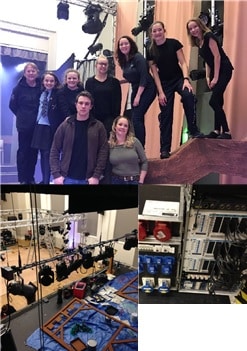
The final few weeks of the Christmas term were very busy for me, as I was helping with the school play ‘As you like it’. Being part of the backstage crew, I assisted the technical director in setting up the fixed lights on the trusses, rewiring many plugs and lights, and set up lots of complex electrical wiring, with help from some of her professional team. The highlight though, was climbing to the top of the Memorial Hall – 3 flights of ladders up! In order to retrieve some gels for the lights. During the performances, I was the Stage Electrician, so I was given the responsibility of setting up all the radio mics, and ensuring they worked, and controlling the smoke machine. Other than this, I had to reset a fuse of one of
the major lights and assemble part of a heavy wooden tree for the set, all during the performance.
A week later, for the Christmas Concerts, I was put on the following spotlight, which meant I had to set up the wiring for my own comms system, and improvise to light up the soloists and instrumentalists during pieces, as well as creating a figure of 8 for the drum roll of the raffle – and I had no prompts!
Outside of engineering, I passed my level 1 in tennis coaching, and competed for the school in an ESU MACE debating competition, where i spoke as part of the swing team, practising both my debating and public speaking skills, which i was complimented on. I received very useful feedback from this which I hope to put in place for more competitive debating competitions in the future.
The next blog will be an update of the F1 in Schools competition, and comes assisted with some videos!!